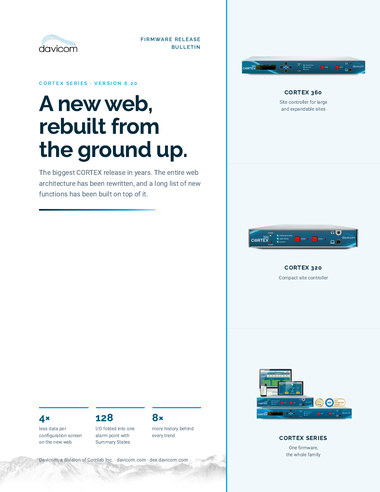
We recently completed a project where we designed a building automation system with voice notifications for city fire stations using our Davicom Cortex RTU units.
To achieve the goals of the project we worked with Komutel and their TARGA Interactive Dispatching Alert solution to implement a workflow that transformed information from the 911 calling center into audio files and building automation commands. Subsequent phases are planned in order to display an on-screen timer as well as to integrate carbon monoxide detectors, open doors, geo-locate trucks, synchronize traffic lights, etc. Statistics will also be compiled on response times achieved.
In short, the city needed to make its operations more efficient and improve response times to alarm calls by automating certain functions in the fire stations and by having voice notifications sent to the buildings’ PA systems. The system was installed in 2019 and has been in operation since the end of 2020 in 3 stations. To ensure that the concept was reliable and ready to be deployed to other fire stations, it was operated in test mode for over one year. This allowed us to iron-out all the small bugs and validate its reliability and robustness.
Installation of the on-site equipment was done by a local Davicom dealer and consisted in installing one Davicom CORTEX unit per fire station for building control (turn off the oven breakers and turn on the emergency lights) as well as to play back alarm-dependent audio files on the PA system. In one of the three stations, audio was also sent to a P25 radio system to notify off-site fire chiefs and other personnel.

Installation Performed by Orizon Mobile, Authorized Davicom Integrator
The overall process happens as described below:
- An alarm call comes in, and once the dispatcher has finished entering the call information, the 911 system sends the calling card to different groups in TARGA. It has a vocal group and a building automation group for the recommended station.
- TARGA does a complete ingest of the information and concatenates everything into the proper order: Recommended station, Nature of call, Time, Address of the incident.
- Using a « text to speech » program, TARGA then transforms the data into a .wav file and sends it to the FTP servers of the 3 Davicom Cortex units installed in the 3 stations.
- Using the SNMP protocol, the TARGA system also sends commands to the Davicom CORTEX in order to play the audio and activate the building automation IF the station concerned is recommended to respond to the alarm. A 3-alarm circular buffer allows a second voice message to be played-out if a first one is already playing.
- The alarm is played-out once on both the P25 radios as well as on the PA system in the 3 stations. And then a second time but only on the PA systems so that the radio channel is available for urgent communications. As an example, the audio playout could read as follows: STATION 50, Nature of the call: Building fire, Time of call: 2:58 p.m., Address: 120 McCune Road.
- The Davicom CORTEX unit will also use its internal relays to turn-off oven and stove breakers as well as to turn on emergency lighting. Latch time and other parameters can be easily set in the software.
The figure below shows the overall system block diagram:

The system is very flexible and can be customized to pretty much any building automation requirement. Since the Davicom Cortex has extra inputs and outputs available for adding sensors and controlling devices, practically any operating scenario imaginable can be realized.
We at Davicom are always available to help.